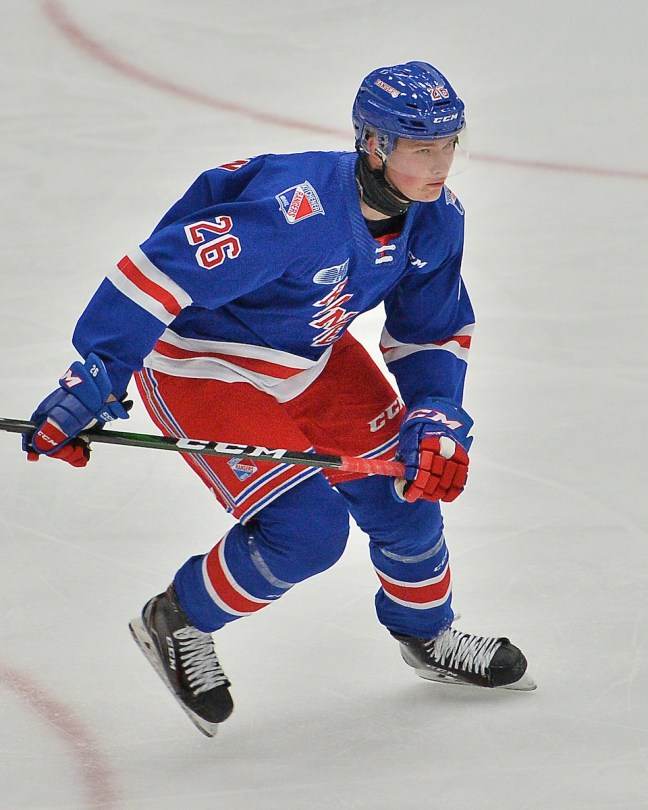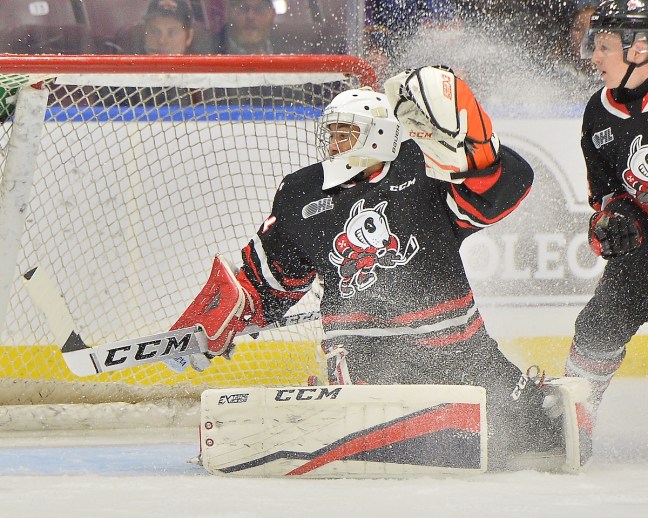
Marco Rossi – Ottawa 67’s – Player Profile

Height: 5’9”

Weight: 187 Pounds

Date of birth: September 23, 2001

Hometown: Feldkirch, Austria

Position: Center

Shoots: Left

OHL Draft: Round 1, 18th overall, 2018 CHL Import Draft

NHL Central Scouting Rankings

Pre-season

November Mid-term Final
A Prospect A Prospect 5 N.A.

6 N.A.

What do Thomas Vanek, Michael Grabner and Michael Raffl all have in common? They are all Austrian born players to have played 470-plus games in the National Hockey League. Ottawa 67’s center Marco Rossi certainly has the potential to not only join that group, but also to be the best Austrian player to skate in the NHL.

As a 16-year-old during the 2017-2018 season, Rossi played in the Swiss Under-20 Elit League with the GCK Lions where he finished ninth in league scoring on 22 goals and 29 assists in 34 games. He would add 5 goals and 5 assists in 9 playoff games and his 10 points were tops in the league.

Selected with the 18th overall pick at the 2018 Canadian Hockey League Import Draft, Rossi would make his way to North America and join the 67’s for the 2018-2019 season and he made quite the impact. Rossi appeared in 53 games, scoring 29 goals and 36 assists for 65 points. Among the Big-Three draft eligible forwards, Rossi, Cole Perfetti and Quinton Byfield, Rossi finished second in rookie scoring and named to the OHL’s Second All-Rookie Team. (Byfield won both OHL and CHL Rookie of the year). Rossi would add 6 goals and 17 helpers in 16 playoff games.

Rossi, Marco
Marco Rossi of the Ottawa 67’s. Photo by OHL Images

Rossi would take things to another level this season. Shortened because of the COVID-19 Pandemic, Rossi appeared in 56 games scoring 39 goals and adding 81 assists. Rossi led or was near the top on almost every statistical category among draft eligible players.

The 67’s had just six games remaining when the season was cancelled, so this is not a small sample size. Rossi led the entire league in assists, points and plus/minus, all by a comfortable margin.

Rossi is without question a top-5 talent for the upcoming draft and one could make the argument that top-3 might be the case. The issue that comes up when anyone talks about Rossi is the 5’9 size. NHL Central Scouting, and teams for that matter, gravitate towards players with size that can skate. The question I am asked most frequently is: If Rossi was 4 inches taller, could he challenge for top pick in the draft?

To me, the answer to that question is yes. I recently had a conversation with Brock Otten, who has his own must follow site, to talk about Quinton Byfield (among other things) and posed that very same question to Brock. You can have a listen below.

Half way through the season, I was told on many occasions Rossi could not sustain his 22% shooting percentage through the entire season and that a serious regression towards the league average was due. Well, he finished the season at 20.2%. Players that were ahead of him like Damien Giroux and Joseph Garreffa saw their shooting percentage drop by three times as much as Rossi. That said, if you watched enough of Rossi last season and this season, you’ll see that one of the most improved assets he has is his shot. He has worked hard in improving his quickness on his release and gained confidence in his shooting ability.

Rossi was always the greatest of skaters, but like his shot, he put in the necessary work to improve. And the difference is night and day. He has superb agility and his edgework is outstanding. He has an excellent ability to change gears. His strength on his feet has also improved and is increasingly difficult to knock off balance, despite his size. He can weave through and dissect defences just with his skating. He is also a possession beast with the puck on his stick.

Rossi is not a full speed ahead north-south player. In fact, he is more of an east-west type player who looks to break defences apart, draw players towards him and then use his patience, vision, possession skills and superb passing abilities to set up teammates for high percentage scoring plays. And without the puck he is elusive, finds open areas of the ice and makes himself an available option. He even goes to the front without the puck.

All the things I’ve mentioned make Rossi a dangerous offensive force, so just imagine how dangerous he is with space on the powerplay. He can run the powerplay from the half wall or he can run it from anywhere else in the offensive zone. With just 7 powerplay markers on the season it’s easy to see he is more of the set-up guy then the shooter – he finished second only to Ryan Merkley on powerplay helpers and powerplay assists per game.

With a September 23 birthdate, Rossi is also further along in his development then his peers – he missed last years draft class by just 8 days so, there should be no doubt that Rossi is one of the better 200-foot players in the draft class.

Rossi is the go-to-guy when the 67’s are down a man. His PK skills are bordering on elite. When leading with a minute to go in the game, he’s the guy coaches look to send over the boards first to protect that lead. His attention to detail when defending is at the same level as it is offensively. His positioning is excellent, he takes lanes away with his stick, and few come back on the backcheck as hard as he does.

Finally, I would like to address the size. Rossi doesn’t play like he’s 5’9”, in fact he plays much bigger. He is usually the first guy on the forecheck with a motor that never quits. He won’t shy away from contact and is always willing to battle against much bigger opponents, and yes, he comes away with the puck more then his fair share of the time. And as mentioned earlier, Rossi is not shy about going to the net.

Many people think he may be better suited to play wing at the NHL level because of his size. And that may be the case. But I think the opportunity has to be given to him to show he can handle the riggers of playing down the m idle in the NHL. The playmaking skills, the commitment to the defensive game are their, as well as being an elite faceoff man.

Rossi’s upside is that of a first line center. At worst, he can be a third line pivot who could turn into an elite penalty killer, take on defensive responsibilities and provide some offence.

Have a listen to my chat with Brock:

Quinton Byfield – Sudbury Wolves – Player Profile

Height: 6’4”

Weight: 215 Pounds

Date of birth: August 19, 2002

Hometown: Newmarket, Ontario

Position: Center

Shoots: Left

OHL Draft: Round 1, 1st overall, 2018 Priority Selection

NHL Central Scouting Rankings

Pre-season

November Mid-term Final
A Prospect A Prospect 2 N.A.

2 N.A.

Sudbury Wolves’ stud Quinton Byfield played his Minor Midget AAA hockey for the York Simcoe Express during the 2017-2018 season where he led the league in goals (48), assists (44) and points (92). He led the Express to an OMHA Championship with his 7 goals and 5 assists in 6 games.

The superb year Byfield had led him to being named the OMHA Player of the Year and brought with him a reputation of winning. Along with the Minor Midget title, he has a Minor Bantam and Bantam Championship on his resume. It led to Byfield being the first overall pick at the 2018 OHL Priority Selection. Here’s what OHL Central Scouting had to say:

Quinton is the type of player that doesn’t come around very often. At nearly 6’4” and over 200lbs, he is an intimidating presence on the ice. He has an exceptionally high skill level and can-do things with a puck that not many players his age or size can do. He is very creative with the puck on his stick and isn’t afraid to try and beat any defender. He is very hard to handle in open ice as he is agile on his skates and uses his edges effectively. Quinton has a cannon for a shot and can shoot in mid-stride.

Of course, Byfield would begin the 2018-2019 season in the OHL. He appeared in 62 games for the Wolves and scored 29 goals and 32 assists. He finished third among OHL rookies in goals, assists and points but he was still named the OHL Rookie of the Year and CHL Rookie of the Year as well as being named to the OHL First All-Rookie Team. Byfield would also represent Canada at the World Hockey Challenge Under-17 and in 5 games scored twice and assisted on another.

Byfield, Quinton (1)
Quinton Byfield of the Sudbury Wolves. Photo by OHL Images

This season began with the Hlinka-Gretzky Cup for Byfield. He scored three times and assisted on two others, but it was a disappointment for the Canadian squad who skated away with a silver medal.

Everyone in the hockey world expected a big season from Byfield with maybe a chance at taking a run at the first overall pick with Alexis Lafreniere. Time away from the Wolves to represent Canada at the World Junior Championships and injuries prevented Byfield from playing a full season (coronavirus aside). However, he was still able to score 32 goals and 50 assists and finish among the draft eligible statistical leaders despite playing in just 45 games.

Now, about that World Junior Championships, too many people are making a big deal about his performance, or lack of productivity (1 assist in 7 games) from Byfield. No one should put too much emphasis on just one tournament and look at the complete body of work. For Team Canada, it wasn’t about the 2020 Championships, but rather the experience and preparation for 2021 should he be available to them. It’s the same approach they took with Lafreniere two years ago and it certainly paid dividends for the National Team.

Byfield isn’t without warts. But one has to remember that with an August birthdate, he is one of the younger players eligible for the draft. In fact, if he was born 17 days later, he wouldn’t be eligible until the 2021 draft. It’s all about finetuning certain parts of his game.

When you watch Byfield, several things stand out. First, is his size. He has a man’s body already – an NHL body. If that doesn’t wow you, then the skating will. He has superb speed despite lugging around his big frame – one wouldn’t think that he possesses such a tremendous separation gear. He’s a force on his skates and almost impossible to knock off the puck. His edgework is elite, able to pivot, turn, start and stop with relative ease.

Also impressive is Byfield’s puck protection and possession skills. He uses his body and reach to keep the puck away from defenders while maintaining possession. Once he has the puck on his stick, it’s like it is attached to a string and the only way it’s coming off is if he passes it or takes a shot.

Byfield’s vision and hockey IQ are also elite. He has the uncanny ability to draw in a defender or two, assess the situation in the blink of an eye and then set up a teammate for scoring opportunities. Rarely do you see him make the wrong decision. He can also beat goaltenders with an elite, NHL ready shot that is overpowering.

I don’t categorize Byfield as a generational talent in the ilk of a Connor McDavid or Sidney Crosby. However, he is the type of player that you can build around and be your number one center. How good he can be will be dependant on how he develops parts of his game as he matures.

I had the opportunity to talk to Brock Otten, founder of OHL Prospects, and a contributor to McKeen’s Hockey. Brock is truly one of the most knowledgeable people out there and his knowledge goes beyond the Ontario Hockey League. And his Twitter is a wealth of information. I urge you to follow his work as you won’t be disappointed. Not only did Brock give his thoughts on Byfield, but other draft eligible players.

Have a listen:

Nick Malik – Sault Ste Marie Greyhounds – Player Profile

Height: 6’2”

Weight: 174 Pounds

Date of birth: April 26, 2002

Hometown: Vitkovice, Czech Republic

Position: Goaltender

Catches: Left

OHL Draft: Round 1, 50th overall, 2019 CHL Import Draft

NHL Central Scouting Rankings

Pre-season

November Mid-term Final
C Prospect C Prospect 5 Euro

10 N.A.

Although Nick Malik has lived most of his life in the Czech Republic, he has both Czech and American citizenship. Malik was born in Raleigh, North Carolina while his father Marek manned the blueline for the Carolina Hurricanes. His Brother Zack is also a hockey player, having played in the OHL for the Sudbury Wolves and North Bay Battalion and played this season in the United States hockey League. Zack is 20 months older and like his father is a defenceman.

Drafted in the first round of the 2019 CHL Import Draft, Malik was also drafted at the 2019 USHL Draft in the 11th round by the Muskegon Lumberjacks, the same team his brother would play for. Because Malik has represented the Czech Republic internationally at IIHF sanctioned tournaments, he is no longer able to represent the United States at such events.

Malik has a wealth of international experience having represented the Czech Republic in Under-16 tournaments twice, the World Hockey Challenge Under-17 twice, Under-18, the World Junior Championships and the Hlinka Gretzky Cup.

Malik, Nick
Nick Malik of the Sault Ste. Marie Greyhounds. Photo by The Sault Star.

The 2018-2019 season saw Malik start 6 games for HC Ocelari Trinec Under- squad and post a respectable 2.41 goals-against-average and a save-percentage of .932. He took his game to another level in the playoffs, leading his squad to a championship with a goals-against-average of 1.74 and a save-percentage of .960 in 8 games, leading all goaltenders in both categories in the playoffs.

This season saw Malik play for HC Frydek-Mistek in the Czech2 league and in 19 games posted a 2.46 goals-against-average and .927 save-percentage. But after the World Junior Championships were completed, Malik decided he would join the Soo Greyhounds. His decision was influenced by fellow Czechian and Soo Greyhound Jaromir Pytlik. On January 10, 2020 Greyhounds’ GM Kyle Raftis made it official and Malik was set to join the team.

Malik’s stats in the OHL were nothing to write home about – a 3.77 goals-against-average and .886 save-percentage. I will be the first to admit I had limited live viewings of Malik in the OHL, but I did watch all of his games in the O whether live or on video. I also saw video of all of his major international competitions. So, “grain of salt” must be added.

Malik plays the butterfly technique extremely well. He has decent size at 6’2” but his ability to keep himself big when down on his knees is close to perfect. He plays with a calm demeanor when there are battles for pucks in front of him and is very adept at taking away the lower part of the net.

As mentioned, things didn’t go particularly well in the Soo. And when they didn’t, Malik appeared to quickly forget what just happened and was ready for the next puck to come his way. To put it another way- he seems to never get rattled. Having experiencing playing against men prior to coming to the OHL may have helped with that.

Malik is extremely athletic in his crease with elite level reflexes. He has a superb glove hand and can snare pucks coming had him he has no business stopping. Despite the superb athleticism, he can sometimes be erratic in his movement in his crease.

Malik also appeared at times to struggle with his angles. One could reasonably accept that there would be a transition stage coming from the larger ice surface in Europe because pucks and players come at you differently. But as the games went on, you could see a comfort level and more confidence creeping into him. That adaptation and confidence was evident in his numbers as well, as they began to improve as he played more.

With any young netminder, there are always areas to improve on, and Malik is no different. While I think his technique is fine, he needs to get better on his skates. Edgework needs to improve; his lateral movement and his post-to-post movement are things to work on. They aren’t areas to worry about as good coaching can help overcome those things.

You have to be impressed by the tools Malik has displayed. It will all come down to putting everything together. Becoming more economical in his movements are key first and foremost. Keeping his athleticism to the level he possesses while playing a more patient and controlled game is also key. A continued growing confidence and becoming more accustomed to North America will only help him.

It’s hard to say how many goaltenders will be drafted from the OHL this season. About the only sure thing is that Nico Gross of the Guelph Storm will go number one. After that, it becomes a personal preference in what order they get selected. In my humble opinion, based on everything I’ve seen around the league, Malik should be the second name called among OHL netminders.

Jan Mysak – Hamilton Bulldogs – Player Profile

Height: 6’0”

Weight: 176 Pounds

Date of birth: June 24, 2002

Hometown: Litvinov, CZE

Position: Left Wing

Shoots: Left

OHL Draft: Round 1, 20th overall, 2019 CHL Import Draft

NHL Central Scouting Rankings

Pre-season

November Mid-term Final
C Prospect B Prospect 9 Europe

28 N.A.

If there is one thing we know about Jan Mysak of the Hamilton Bulldogs it is that he does nothing but put up points wherever he goes. Consider this: As a 15-year-old during the 2017-2018 season Mysak skated for HC Litvinov Under-16 (12 games – 41 goals – 18 assists), HC Litvinov Under-18 (36 games – 30 goals – 23 assists) and HC Litvinov Under-20 (6 games – 2 goals – 6 assists). Once again: As a 15-year-old.

Mysak began the following season with the HC Litvinov Uner-19 squad. In 9 games he accumulated 13 goals and 9 assists. But then he signed with HC Litvinov of the Czech Extraliga. Just when you think he struggled with just 3 goals and 4 assists in 31 games, when the playoffs came around, Mysak took matters into his own hands scoring 5 goals and 4 assists in 6 games and saving his squad from relegation. That’s against men, as a 16-year-old.

Mysak, Jan
Jan Mysak of the Hamilton Bulldogs. Photo by Hockey Herald

Mysak also brings a wealth of international experience on his resume. He has participated in the World Hockey Challenge Under-17, World Junior Championships Under-18, World Junior Championships Under-20 and the Hlinka-Gretzky Cup among others. In total, he has 58 international games under his belt and scored 22 goals while assisting on 22 others in those contests.

Mysak was drafted by the Hamilton Bulldogs with the 20th overall pick at the 2019 CHL Import Draft. On January 9, 2020, Mysak signed with the Bulldogs and the door was open for him to join the OHL squad. It couldn’t have come at a better time for Hamilton as they lost Jan Jenik to an injury at the World Junior Championships. Mysak would finish the season with 15 goals and 10 assists, and despite playing in just 22 games, finished 17th among rookies in scoring. That’s almost identical in points per game (1.136) to Kingston Frontenacs phenom Shane Wright (1.137). There’s just no telling what kind of numbers Mysak could have put up with Jenik and Arthur Kaliyev and Jenik not been injured.

There were a few concerns about how Mysak would handle the transition to North America and being away from home for any length of time for virtually all his hockey life, seeing that he’s only played for one team, his hometown Litvinov. The transition could not have gone any better.

Mysak isn’t exactly a physical player. But that doesn’t prevent him from battling along the walls or getting into the slot. He’ll take a hit to make the play and won’t shy away from taking a physical beating. If he comes away with the puck in those battles, he can create opportunities for himself and has the elite vision and playmaking skills to set up his teammates. He is also an excellent puck possession player. He has an elite wrist shot and his backhand is as good as anyone’s.

Mysak’s skating was questioned in some circles prior to coming to the OHL. Granted, it’s a small sample size, I didn’t see it. Technically, he is a very good skater with long strong strides, His top end speed, while not elite is good enough. He possesses a separation gear that. He is very efficient at turning and skating backwards.

Mysak is an extremely intelligent player who can play in any and all situations. At times, he ran the powerplay for the Bulldogs from the point where he showcased his vision and playmaking skills. He is also very good on the penalty kill and a threat to score when down a man – evidenced by two of his first five OHL goals came while on the PK.

Mysak is also very adept at the defensive game. He comes back hard on the backcheck and applies pressure to the puck carrier extremely well, especially before they enter his zone, and he creates a lot of turnovers that way. His positioning is sound and he keeps his stick in lanes, taking them away effectively. He also has the ability to be a one-man breakout.

Mysak projects very well to the NHL. Skating, hockey sense, shot, IQ all trend to NHL level. He can be a top six NHL’er with a 200 foot-game.

Ville Ottavainen – Kitchener Rangers – Player Profile

Height: 6’4”

Weight: 204 Pounds

Date of birth: August 12, 2002

Hometown: Oulu, Finland

Position: Defence

Shoots: Right

OHL Draft: Round 1, 35th overall, 2019 CHL Import Draft

NHL Central Scouting Rankings

Pre-season

November Mid-term Final
C Prospect C Prospect 71 N.A.

137 N.A.


Hulking Kitchener Rangers defenceman Ville Ottavainen has followed fellow Finnish OHL’ers Ruben Rafkin and Kari Piiroinen, both of the Windsor Spitfires and signed a professional contract to play in his native Finland for the 2020-2021 season, though as the tweet mentions, his preference is to return to the OHL which might indicate there is an “North American out clause” in his contract.

One can’t help but wonder if the COVID-19 pandemic is playing a role here as restrictions in Europe will likely end before the restrictions in North America do, meaning hockey could return in Europe before North America.

During the 2018-2019 season, Ottavainen played for Karpat Under-18 in Finland’s Junior B SM-Sarja league. In 49 games he scored 9 goals and assisted on 25 others and was named to the First All-Star squad at the end of the season. The Rangers selected him with the 35th pick at the 2019 Canadian Hockey League’s Import Draft.

Ville Ottavainen of the Kitchener Rangers. Photo by Terry Wilson / OHL Images.

Ottavainen appeared in 53 games for the Rangers this season and scored 4 goals to go along with 11 helpers. His father Risto, played 4 seasons in Finland’s Suomi-Sarja league – Finland’s third highest league.

First and foremost, everyone is going to notice Ottavainen’s size. At 6’4” and 200-plus pounds, he’s already in a man’s body and he doesn’t turn 18 until August 12th. But for a player of his size, he has pretty good mobility. And he is a right-handed shot – something NHL teams are always looking for.

NHL Central Scouting dropped him 66 spots from their mid-term ranking (71st among North Americans) to their final rankings (137th among North Americans). Whether that’s fair or not, you be the judge.

Ottavainen got off to a blazing start, causing most of his offensive damage in the first 15 games scoring 4 goals and 6 assists in that time, but managed just 5 assists in the remaining 38 games (and two of them came in one game). So, any questions surrounding his adapting to the North American ice should have been laid to rest in those first 15 games, right? So, what happened?

Well, for one Ottavainen saw his ice time drop as the season progressed, especially after the Rangers acquired veteran Holden Wale in a trade with the Soo Greyhounds. As a player though, you have to make the most of the opportunities presented to you. It’s no fault of his, Wale was just a very experienced OHL’er

If you are a reader of some of the independent draft publications available to you, there are a couple questions regarding Ottavainen. One of them is his first step speed. Well, he has such a long reach, he keeps the opposition close enough that he effectively uses that reach to his advantage. Defensively, there isn’t much need for him there, but it could help the transition game. But he is such a mobile and agile skater that I don’t see the lack of blazing speed as an issue.

Another issue is his questionable decision making. I don’t really buy into that. He is one of the youngest defenders in the draft class and he has shown the ability to make very good passes and his playmaking skills are very good and he moves well enough to jump up into the play. Did we mention he has a booming shot? As he gains experience and confidence, this won’t be an issue, and maybe playing pro in Finland is a blessing in disguise.

There are also issues raised with his defensive game. Truth is, we can say that with just about every blueliner at this level. Does Ottavainen make more then his share of mistakes? Probably, yes. But being that it is his first time on the North American ice and that he played the entire season as a 17-year-old, well there is a transition that needs to take place and a lot more projection to take place here.

We think the tools are there in Ottavainen’s tool box. For an NHL team drafting him, it’s going to take a lot of patience waiting for the tools to develop and it’s going to take some good coaching at the development level. If there’s a team that could provide both, then they’ll have a good find here.

We asked Mike Farwell (@farwell_ohl), the color voice of the Kitchener Rangers on 570 News to provide us with a quick thought:

One of the first things you’ll notice about Ville is his skating. He’s got a smooth and easy stride and it makes him a solid puck-mover. Ville’s decision-making is also above average, quick and confident, seeing him make the right — even safe — play more often than not.

Ethan Cardwell – Barrie Colts – Player Profile

Height: 5’11”

Weight: 180 Pounds

Date of birth: August 30, 2002

Hometown: Courtice, Ontario

Position: Center/Right Wing

Shoots: Right

OHL Draft: Round 2, 33rd overall, 2018 Priority Selection (Saginaw Spirit)

NHL Central Scouting Rankings

Pre-season

November Mid-term Final
C Prospect N.R. 104 N.A.

70 N.A.

Its quite possible that, according to NHL Central Scouting’s lists, there is no bigger enigma then Barrie Colts forward Ethan Cardwell. Coming into the season NHLCS had him as a C – Prospect, to unranked in November to 104 (among North Americans) on their mid-term to 70 (among North Americans) on their final rankings. That is about as close as you can get to the definition of all over the map.

Cardwell played Minor Midget AAA hockey during the 2017-2018 season with the Clarington Toros and in 35 games scored 30 goals and assisted on 24. He went on to play the final 2 regular season and playoffs with the Wellington Dukes of the Ontario Junior Hockey League where they captured the Buckland Cup. Cardwell also represent Team OMHA Black at the OHL Gold Cup, scoring twice in two games and capturing Bronze.

Cardwell’s grandfather Steve played junior hockey with the Oshawa Generals and spent 3 seasons with the Pittsburgh Penguins in the NHL and 2 in the WHA. His father Justin played NCAA hockey with Western Michigan before going on to have a lengthy career in the ECHL, AHL and IHL. His Uncle Matt also played hockey, most notably for York University and had a brief 9 game stint of professional hockey in the ECHL.

The 2018-2019 season was a whirlwind season for Cardwell that almost required a program to keep track of.

Ethan Cardwell of the Barrie Colts. Photo by Terry Wilson / OHL Images


Cardwell began the season with the Saginaw Spirit training camp and got into some exhibition games. But the Spirit sent him to the OJHL and the Trent Golden Hawks who had just acquired his rights in a trade. He got called up to the Spirit on December 8 and would score his first OHL goal in that contest. After a brief stint he was back in the OJHL, this time with the Pickering Panthers before coming back to Saginaw to finish out the year.

This season was a slow start for Cardwell, who posted 4 goals and 4 assists in his first 15 games. The numbers aren’t particularly bad, but considering 5 of those points came in just 2 games, one could suggest there was consistency issues in terms of providing offence. The next 22 games for Saginaw saw him score 8 goals and 5 assists.

But on January 10, 2019 in a blockbuster deal, the Barrie Colts acquire Cardwell, Connor Punnett and draft picks while sending Nick Suzuki to the Spirit. That’s when things took a turn offensively for Cardwell as he scored 11 goals along with 15 helpers in 26 games.

There were many questions about Cardwell that were unanswered until the trade to Barrie.

What is evident first and foremost is Cardwell’s extremely high hockey IQ. In the offensive zone, he alludes defenders and finds those soft spots almost unnoticed and when teammates find him, he releases an above average wrister with a superb release. He uses that same IQ defensively. As one of the youngest players available in the draft class, his defensive abilities and understanding is ahead of most of his peers. His positioning is superb, he gets into lanes with his body or stick and does extremely well at creating turnovers.

Cardwell is a good technical skater, good edges and control, strong on his blades and agile. However, he lacks speed in both his first strides and top end. If he can continue to work on his speed that would help him even more. What we do know is that Cardwell is an extremely hard worker so putting in the effort is something we expect from him.

Cardwell has shown he can play up and down the lineup and play an offensive role with talented players, or take on a checking role on a lower line. By all accounts, he is a coachable kid willing to do whatever is asked of him.

In Saginaw, Cardwell did very well on the faceoff dot at 58.5% but took a big dip in Barrie at 35.8%. But he spent most of his time in both cities on the wing. I would like to see him with more time in the middle to make a definitive decision on which position he is best suited for.

As of now, I believe Cardwell’s upside is of a defensively responsible third liner who could kill penalties and provide some offence at the next level with an ability to move up the lineup in a pinch. If he can add some speed, he could end up on a second line.

Evan Vierling – Barrie Colts – Player Profile

Height: 6’0”

Weight: 167 Pounds

Date of birth: June 20, 2002

Hometown: Aurora, Ontario

Position: Center/Left Winger

Shoots: Left

OHL Draft: Round 1, 2nd overall, 2018 Priority Selection (Flint Firebirds)

NHL Central Scouting Rankings

Pre-season

November Mid-term Final
C Prospect C Prospect LV

66 N.A.

It’s been a path worth watching as Barrie Colts pivot Evan Vierling has his sights set on the National Hockey League Draft (whenever that may come). Vierling, the second overall pick of the Flint Firebirds at the 2018 Ontario Hockey League Draft, played his Minor Midget AAA hockey with the York Simcoe Express during the 2017-2018 season (OMHA Minor Midget AAA Champions). In 33 games, he amassed 27 goals and 36 assists and added 4 goals and 6 assists in 6 playoff games.

Vierling and the Express went on to the OHL Cup where Vierling scored 5 goals and 5 assists in 6 games. It was Vierling’s second appearance at the tournament with the Express, posting identical numbers during the 2016-2017 season.

Here is what OHL Central Scouting had to say about Vierling:

Evan is a smooth skating centre that has very good offensive instincts. He is one of the nicest skaters in the draft, plays a good 10-foot game, has a long, powerful stride and is very agile on his skates. He has a great skill set and can makes plays at full speed. He is a smart player that understands the situations of a game and makes very few mistakes. He plays a simple but effective game. Evan was a big part of the success his team had in the second half.

Evan Vierling of the Barrie Colts. Photo by Terry Wilson / OHL Images

Vierling appeared in 60 games during his rookie OHL season with the Firebirds. He scored 6 goals and assisted on 21 others. He would also represent Canada at the World Hockey Challenge Under-17 where he had a leadership role and in 6 games scored twice and assisted on another.

This season was somewhat of a challenge for Vierling. He began the year with the Firebirds scoring 2 goals and 8 helpers in the first 15 games. But Vierling wanted to be closer to home and went back home to Toronto while awaiting a trade.

On January 7, that trade finally came to fruition as the Colts send Tyler Tucker and Riley Piercey to the Firebirds for Vierling and a pair of draft picks. Vierling told CTV Barrie “This is the team I looked up to, so it’s cool to play here.”

The trade paid dividends to both Vierling and the Colts. Vierling appeared in 28 games following the trade scoring 12 goals and 22 assists. He went pointless in his last 5 games with the Firebirds, He was held off the scoresheet in his first game with the Colts (did he need to shake off some rust?) but then recorded points in 13 consecutive games. He was held off the score sheet just 5 times in 27 games and back-to-back just once. And despite playing just 28 games with the Colts, his 34 points ranked 6th in a Colts uniform.

A season ago, the knock on Vierling was a simple one: while he showed he had some skill, too often he stood still and lacked consistency from shift to shift. I think his brief time with the Colts can lay that to rest.

Vierling is a two-way pivot who is more of a playmaker then a goal scorer. While he did have a 12.2 shooting percentage overall (14.6% with the Colts), he did start shooting more with in Barrie (2.9 shots per game) then Flint (2.2 shots per game). He is however, more dangerous setting up teammates. He is a highly skilled passer who is dangerous from the hashmarks with an uncanny ability to find teammates on the back door.

Vierling is a very good technical skater with a smooth stride. He doesn’t have explosive speed and lacks a separation gear, but if he can continue to work on those traits, there is no telling how far he can go. Combined with his confidence and vision and ability to transition and maintain puck control, he can be even more dangerous.

Right now, Vierling projects as a third liner that won’t hurt you defensively and provide a bit of offence. His ceiling may be that of a second liner who can run your second powerplay unit from the half wall considering his playmaking abilities and how dangerous he is with space. I think his game is better suited down the middle rather then on the wing.

OHL Draft Eligible Players: Risers and Fallers

Yesterday National Hockey League Central Scouting released its final rankings for the 2020 Draft. There will always be questions about players asking why Player A was ranked so low, or why was Player B not ranked. Those are questions to be answered another day, but I have just one comment:

That said, there was some serious movement from the mid-term rankings to the final rankings.

Luke Evangelista was moved ahead of teammate Antonio Stranges.

The biggest drop belongs to Ilya Solovyov from 119 to not ranked, down 99 spots.

The biggest jump belongs to Evan Vierling from limited viewing to 66, a jump of 152 spots.

Teammates Jean-Luc Foudy and Will Cuylle, long considered 1st round material are now mid 2nd round.

Here are the list of players showing their mid-term versus their final rankings along with the difference in rankings. Players are listed in order of NHLCS final rankings.

Player Mid Final Diff.
Quinton Byfield 2 2 0
Jamie Drysdale 3 3 0
Marco Rossi 5 6 -1
Cole Perfetti 4 5 -1
Jack Quinn 9 7 2
Jacob Perreault 17 17 0
Tyson Foerster 41 21 20
Ryan O’Rourke 32 27 5
Jan Mysak 9 Euro 28
Martin Chromiak 35 Euro 30
Jean-Luc Foudy 20 33 -13
Will Cuylle 21 34 -13
Brandon Coe 47 35 12
Luke Evangelista 58 39 19
Jaromir Pytlik 38 46 -8
Tyler Tulio 54 52 2
Oliver Suni 45 53 -8
Zayde Wisdom 90 54 36
Antonio Stranges 39 56 -17
Donovan Sebrango 59 59 0
Jack Thompson 67 60 7
Evan Vierling L.V. 66 152
Tanner Dickinson 55 67 -12
Ethan Cardwell 104 70 34
Rory Kerins 74 72 2
Robert Calisti 137 78 59
Ruben Rafkin 72 84 -12
Hayden Fowler 66 87 -21
Kirill Steklov 69 106 -37
Pavel Gogolev 105 107 -2
Evginiy Oksentyuk 79 109 -30
Isaak Phillips 76 114 -38
Oli Bjorgvik-Holm 140 116 24
Riley Piercy N.R. 129 89
Ville Ottavainen 71 137 -66
Cameron Butler 100 138 -38
Jake Uberti 202 147 55
Reid Valade 123 148 -25
Declan McDonnell N.R. 155 63
James Hardie 213 163 50
Louka Henault 201 171 30
Igor Chibrikov 156 188 -32
Logan Morrison 184 190 -6
Tye Kartye 173 192 -19
Jakob Murray 155 193 -38
Lleyton Moore N.R. 194 24
Austen Swankler 200 200 0
Maxim Golod N.R. 213 5
Brendan Hoffman 217 217 0
Luca Profaca 185 N.R. -33
Kyle McDonald 216 N.R. -2
Anthony Tabak 199 N.R. -19
Andrei Bakanov 203 N.R. -15
Dylan Robinson 138 N.R. -80
Ilya Solovyov 119 N.R. -99
Goalies
Nico Daws 1 1 0
Will Cranley 16 4 12
Nick Malik 5 Euro 10
Ty Austin 21 14 7
Owen Bennett 13 24 -11
Aidan Campbell 28 28 0
Brett Brochu NR 29 +3
Mack Guzda NR 31 +2
Zachary Papoutsakis 30 NR -2
Marco Costantini NR NR 0
Tucker Tynan NR NR 0

Tucker Tynan – Niagara IceDogs – Player Profile

Height: 6’0”

Weight: 159 Pounds

Date of birth: June 7, 2002

Hometown: Chicago, Illinois

Position: Goaltender

Catches: Left

OHL Draft: Round 10, 192 overall, 2018 Priority Selection

NHL Central Scouting Rankings

Pre-season

November Mid-term Final
N.R. N.R. N.R.

N.R.

During Tucker Tynan’s OHL draft year, he played for the New Jersey Rockets of the National Collegiate Develop Conference. The NCDC is a developmental conference in the northeast United States under the umbrella of the U.S. Premier Hockey League whose mission is to develop players for the NCAA.

Tynan appeared in 24 games for the Rockets posting a 3.31 goals-against-average (11th in the NCDC) and a sparkling .924 save-percentage (5th in the conference).

Prior to joining the Rockets, Tynan played Minor Midget Tier 1 hockey with Little Caesars Under-16 squad during the 2017-2018 season. He appeared in just 5 games but posted incredible numbers with a .80 goals-against-average and .956 save-percentage. The IceDogs were able to select Tynan in the 10th round of the 2018 Priority Selection – 192nd overall.

Tucker Tynan of the Niagara IceDogs. Photo by Terry Wilson / OHL Images.
Tucker Tynan of the Niagara IceDogs. Photo by Terry Wilson/OHL Images

Much wasn’t known about Tynan coming into the season and NHL Central Scouting didn’t have him on either of their Players to Watch lists, though he soon started garnering attention.

But on December 12, 2019, everything came to a halt. In a game against the London Knights during the second period, one of the Knights players was knocked down on his way to the net, entering Tynan’s crease skate first. His skate caught the young netminder in the leg causing a gruesome and scary injury. (we won’t post the video here.) At the time, the IceDogs said if it weren’t for the immediate actions of the IceDogs and Knights training staff and the immediate medical attention, it could have cost him his life. Tynan required emergency surgery and the game was never completed.

Up until that moment, every bit of attention Tynan was getting was warranted. He was among the league leaders in most goaltending stats, including shots faced. Tynan, quite simply gave the IceDogs a chance to win every game. At that point of the season he was easily their most valuable player.

Let’s look at some of those numbers. Tynan appeared in 23 games and ended with an 11-8-3-1 record. Not Earth shattering without context, right? Tyan faced 50 or more shots on 4 occasion and boasted a .920 save-percentage and a 1-2-1-0 record. He faced 40 or more shots on 12 occasions with a 5-5-2-0 record and .905 save percentage. He finished with a 6-3-1-1 record when facing 39 or fewer shots.

The IceDogs record without Tynan: 7-31-2-0. Despite playing in just 23 games, he finished 24th in shots faced with 916 or 39.8 per game. By comparison, Jacob Ingham of the Kitchener Rangers led the league in shots faced with 1636, or 35.5 per game.

Sure, some of that decline was the fact that the IceDogs traded away star Philip Tomasino at trade deadline. But that should have hurt their goal scoring more then their goals against. The IceDogs goals against went up drastically from the 3.56 with Tynan to 5.80 without.

If the eye test wasn’t enough to tell a story, the numbers should be.

By all accounts, Tynan is doing very well in his recovery and well on his way to returning to the game. But one must ask themselves if they believe the type of injury he received and how it happened will impact his mental part of the game. No way! At least not in my opinion. Tynan was unflappable in his net. Whether it was a bad goal he had given up or his d-men making a bad play in front of him, it was his let’s move on and forget about it attitude that says this kid has a good mental makeup.

Tynan isn’t the big bodied netminder NHL teams drool over. He is an extremely athletic netminder and a superb skater. His post-to-post movement is at an already elite level. His ability to move out to the top of the paint and challenge shooters is top level, however he doesn’t take up as much of the net as the bigger goalies so he is going to require improvement on that to succeed at the next level.

Tynan is very adept in tracking the puck and remaining focused. But the size is once again coming into question here as it impacts him on his ability to see through traffic and to take up as much of the net as possible when players are scrambling in front of him. But he plays the butterfly technique almost to perfection and he stays as big as he can while down so if you’re going to beat him, it has to be down low.

We here at OHLW have a lot of admiration for Tynan, one of the youngest goalies available for the draft. Sure, the injury hurt his draft stock and there will be concerns about his mental makeup going forward. But we believe in him, and think someone should take a late round flier at the draft. But we also believe his potential is better than a late round flier.

Owen Bennett – Guelph Storm – Player Profile

Height: 6’3”

Weight: 202 Pounds

Date of birth: April 11, 2002

Hometown: Georgetown, Ontario

Position: Goaltender

Catches: Left

OHL Draft: Round 4, 67th overall, 2018 Priority Selection

NHL Central Scouting Rankings

Pre-season

November Mid-term Final
N.R. C Prospect 13 N.A. Goalies

24 N.A. Goalies

Guelph Storm netminder Owen Bennett played his Minor Midget hockey during the 2017-2018 season, strapping on the pads for the Halton Hurricanes. In 19 games, Bennett posted a 2.61 goals-against-average. The Storm would select Bennett with the 67th overall pick at the 2018 Priority Selection, making him the eighth goaltender selected.

During the 2018-2019 season, Bennett would play Tier 2 hockey with the Carlton Place Junior Canadians of the Central Canada Hockey League. Bennett would go on to post a 2.48 goals-against-average and .909 save percentage in 29 games, finishing second and first respectively among rookies, and tenth and fourth respectively overall.

Owen Bennett of the Guelph Strom. Photo by Terry Wilson / OHL Images.
Owen Bennett of the Guelph Storm. Photo by Terry Wilson/OHL Images

Bennett is ranked second among OHL Goaltenders by NHL Central scouting as of their mid-term rankings. The question surrounding Bennett coming into the season was “How much playing time would he get?” considering the top ranked goaltender is teammate Nico Daws, who was passed over at the 2019 NHL draft and is re-entering the draft.

A World Junior Championship appearance and an injury to Daws opened the door for Bennett and he appeared in 27 games for the Storm, fourth most by first time draft eligible goaltenders. He finished ninth in goals-against-average at 3.92 and eighth in save percentage at .881.

Bennett has the size that seems to draw scouts at 6’3” – he pretty much has the same frame as Daws. But he does have some areas that need work. Not a major concern however as with good coaching, those areas can be improved. And pairing with Daws, who went through similar things can only be beneficial for the young netminder.

Working on his positioning is one area Bennett needs to work on. He doesn’t get out to the top of the blue paint as far as he should in some situations. His post-to-post movement isn’t exactly slow, but I think with an adjustment to his technique and “pushing off”, he can improve in that area. Consistency can be an issue as he sometimes looses the net and can be beat by poor coverage of the cage. I don’t think it’s due to a lack of concentration. He seems to never get rattled, even when he gives up a softie.

Bennett fights through traffic to keep his eyes on the puck extremely well. And when things are in tight, he plays the butterfly position well and keeps himself big to take up a lot of the net. His rebound control is actually pretty good. He has an active blocker and his glove is above average for a goaltender of his age.

We like the tools Bennett has and the concerns over areas that need working on don’t scare us away. Bennett is in a good situation in Guelph with coaching and Daws as his partner. And we’re confident in saying that he’s willing to put in the necessary work.