The calendar has flipped to December and it’s time to look at various statistical leaders among the Ontario Hockey League players eligible for the 2016 National Hockey League Draft.
As always, we only look at players eligible for the first time – those previously passed over are not included – except for goaltenders where we included those passed over a year ago.
Alex DeBrincat of the Erie Otters. Photo by Aaron Bell/OHL Images
Alex DeBrincat of the Erie Otters leads not only the draft eligible players in points, but the entire OHL. He’s averaged a hair over 2 points per game with 52 in 25 games. He’s followed closely by the London Knights’ Matthew Tkachuk at 48 points in 24 games. DeBrincat’s teammate Taylor Raddysh is at the head of the next tier with 40 points in 26 games while Alexander Nylander closes out the top 5 with 39 points in 28 games.
DeBrincat also leads the entire OHL in goals with 31, a pace that would equal the OHL record for goals in a season of 87. Nylander sits way back in second with 17 goals followed by the Flint Firebirds’ Will Bitten with 14. Tkachuk and the Kitchener Rangers’ Adam Mascherin follow with 12 a piece.
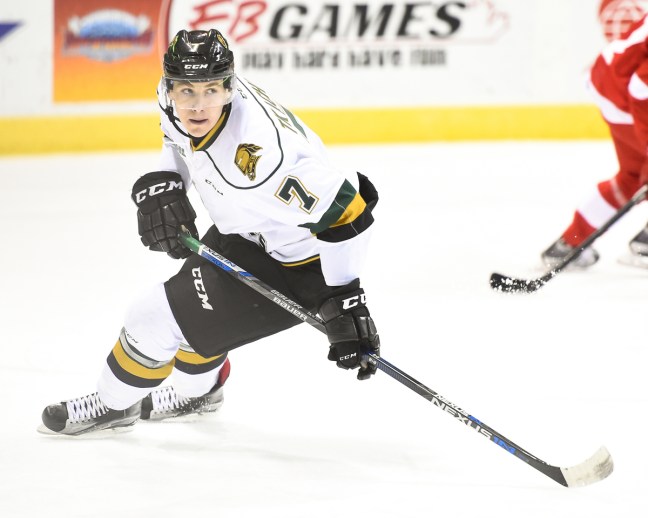
On defence, the Knights’ Olli Juolevi leads the blue liners with 20 points
Olli Juolevi of the London Knights. Photo by Aaron Bell/OHL Images
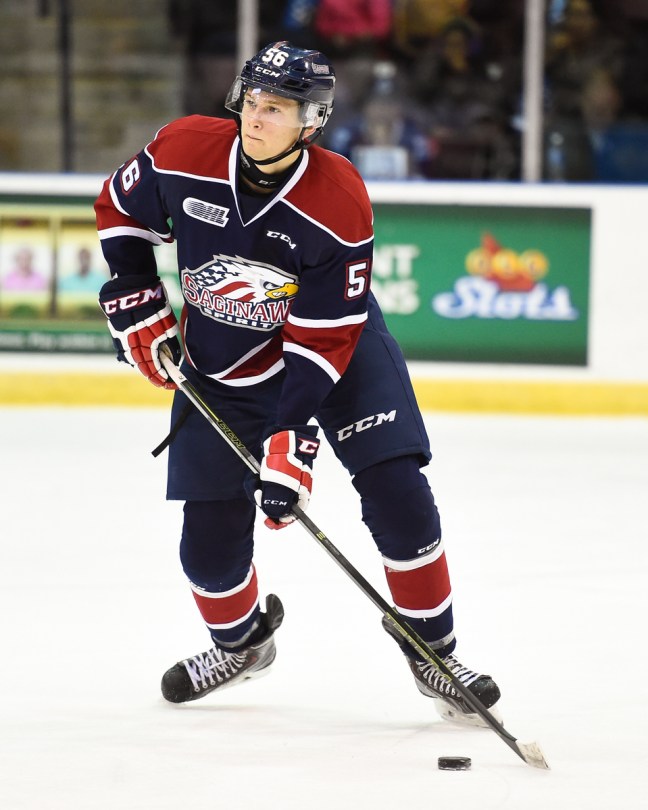
in24 games. Markus Niemelainen of the Saginaw Spirit is close behind with 18 points in 26 games followed by Cam Dineen of the North Bay Battalion with 17 and Mikhail Sergachev of the Windsor Spitfires with 16 in 27 games. It’s interesting to note that the top four are all rookies.
It’s December and while most of us prepare for Christmas, the Ontario Hockey League’s players eligible for the 2016 National Hockey League Draft continue to work towards their goal – being selected in that draft.
Matthew Tkachuk of the London Knights. Photo by Aaron Bell/OHL Images
Each month, I look at the best of the best and provide you with who I believe the top performer was – and for November, that honor belongs to the London Knights’ Matthew Tkachuk.
In ten November games, Tkachuk scored 7 goals, 5 of which came on the power play. He added 19 assists to those 7 goals. In only one contest, did Tkachuk not post an assist. And in only two other games was he held to just one lone helper. In the remaining 7, Tkachuk had multiple assists.
Tkachuk finished the month with a plus 6 and 18 penalty minutes.
Tkachuk currently sits third in OHL scoring with 12 goals and 36 assists in just 24 games. He’s 23 for 48 in the faceoff circle – 47.9% – and his 12 goals come on 84 shots on goal – 14.3%.
Also considered were last month’s winner Alex DeBrincat of the Erie
Alex DeBrincat of the Erie Otters. Photo by Aaron Bell/OHL Images
Otters and his teammate Taylor Raddysh.
DeBrincat played in 12 games and contributed 14 goals and 13 assists while Raddysh had 7 goals and 14 assists. In goal, Tyler Parsons of the Knights appeared in all but two games with a 6-2-0 record while posting a 2.28 goals against average and a .915 save percentage.
Even in a casual conversation, Day sounds like a young man searching hard for an upside to his decision to enter major junior a year ahead of his class. “A lot of people would say that [my rookie season] was a bad year, but I think it was good for my development,” he says. “I went into that season not knowing a lot about defence. I wanted to jump up into the rush a lot. I had to learn about playing in my own end, thinking defence before offence. Even coming in as a 16-year-old in your first season, it’s tougher [than other positions] because you’re the last line of defence and all eyes are on you. And there’s just that much more scrutiny on you as an exceptional player. They want to see something exceptional every shift.”
The scouts’ eyes will be trained on Day this winter. When quizzed by NHL Central Scouting this fall, Day was asked what aspect of his game he has to work on. Most kids cite strength or skating when the question is posed. These, however, aren’t holes in Day’s skill set. His reply was a rare one, exceptional in its own way, but honest: “Weight control,” he told them.
In its early-season rankings, NHL Central Scouting had Day as a “B prospect,” projecting him to be a second-rounder at best. Day expressed disbelief when asked about mock drafts that have him falling off the first-round grid. “I’m not going to say the clichéd answer about not looking at the draft lists,” he says. “Everybody does. I know what people have said or written about me. People forget I’m 17. I have a whole season to help my [draft] stock. When I see the draft boards and I’m not even in the first round, I just tune it out and say to myself, ‘C’mon, that’s dumb.’”
This first appeared on Sportsnet and is an excellent read for everyone. Find the complete article here.
KHL Draft: Round 3, 63rd overall, 2015 KHL Draft, Dynamo Riga
Niemelainen enters his draft year as one of the most internationally experienced players available for the NHL Draft. He’s played for Finland at the U-16, U-17 and U-18 as well as the WHC U-17, WJC U-18 and the Ivan Hlinka Memorial.
Prior to being selected in the CHL Import Draft, Niemelainen was selected in the KHL Draft. That was followed by being selected by the Fargo Force in the USHL Entry Draft (13th round, 199th overall).
There are a few 6’6” defensemen available from the OHL in the draft class that include Niemelainen’s teammate Keaton Middleton and the Windsor Spitfires Logan Stanley. But unlike his draft cousins, he will need to add plenty of bulk to that imposing frame.
Markus Niemelainen of the Saginaw Spirit. Photo by Aaron Bell/OHL Images
Niemelainen moves surprisingly well for a player of his size. Despite that skating ability, he’s a pass first defender when trying to clear the zone – a pass he completes extremely well. He also shy’s away from using that skating ability to join in the rush offensively. He’s not a risk taker and plays it extremely safe in that regard. The tools are there and I think the more he becomes accustomed to the North American game, the more they will come to the forefront.
In the offensive zone Niemelainen is not averse to taking chances. However, he’ll need to better choose when to pinch and when to back off. He sometimes shows hesitation or indecisions on when to pinch and can leave himself out of position. He has a deceptively quick release on his shot and he shoots with a purpose – whether he’s shooting to create a rebound or a shot that can easily be tipped in by a teammate. He does possess some intriguing offensive abilities and the vision to be creative.
Defensively, Niemelainen is excellent in his positioning. He knows where to be on the ice and is very adept at blocking lanes. He has a very active stick and his reach is one of his biggest assets. Despite his imposing size, he’s not as physical as he can be – he shows hesitation when the hit is there. Perhaps it’s because he worries about leaving himself out of position or perhaps it will come with the adjustment to the smaller rink and the North American game.
Niemelainen appeared on NHL Central Scouting’s list of players to watch on their preliminary list as a B prospect and remained there on the updated November list. A B prospect is a second or third round prospect.
Niemelainen could very well turn out to be a low risk high reward pick.
When your teammates include the likes of Alexander Nylander and Michael McLeod, (not to mention exceptional status player Sean Day) you can be certain that NHL scouts will converge on the Hershey Center in Mississauga Ontario. If your name is Nathan Bastian, you are going to draw attention.
Bastian entered the season on NHL Central Scouting’s preliminary list of players to watch as a B prospect (second or third round pick) and through the first one-third of the Ontario Hockey League season, was moved up to an A prospect (first round prospect) on their November list. And it is merited.
Prior to the OHL draft, Bastian played Midget for the Kitchener Junior Rangers. He appeared in 55 games and scored 22 goals and 25 assists. The following season he split time between the Brantford 99’ers of the Greater Ontario Junior Hockey League (Junior B) and the Steelheads. In 48 games for Brantford, Bastian scored 17 goals and 29 assists. He got the call up to Mississauga and in 19 games scored twice with one assist.
Last season was his first full OHL season and Bastian appeared in all 68 games for the Steelheads notching 17 goals and 12 assists. To date this season, he’s already surpassed his assist high in the OHL and 25 goals and 70 points on the season are not out of reach.
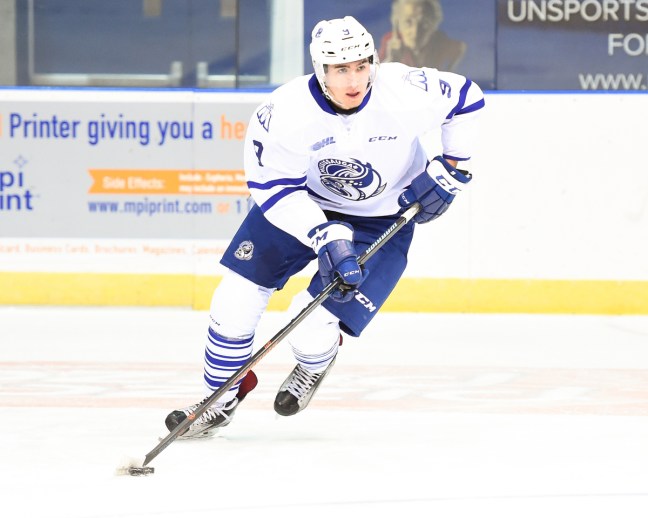
Nathan Bastian of the Mississauga Steelheads. Photo by Aaron Bell/OHL Images
At 6’4” Bastian has very good size and while he’s never been “soft” is using his size more effectively and beginning to play with an edge. His skating and speed are above average which allows him to get on top of defenders, almost always finishing his checks. His smarts, relentless pursuit and anticipation cause opposition turnovers.
Offensively, Bastian has good puck skills. He reads plays very well and has very good vision and excellent playmaking skills. He’s not afraid to drive to the net and is very good at finishing in close. He has a very good shot and is not hesitant to use it. He’s currently at 15.3 shooting percentage. He’s had the opportunity to play with both Nylander and McLeod and has shown he can “keep up”.
Defensively, Bastian does very well. He can play a complete 200 foot game. He gets into passing lanes and has a very active stick – and at 6’4”, you know he has the reach. He will not shy away from getting into the shooting lanes and blocking shots. He’s also been a steady contributor for two seasons on the Steelheads penalty kill.
One area Bastian will need to work on is his faceoffs. Just 23 games into the season he’s 47 for 105, or 44.8%. Not to worry, faceoffs are something that can be improved on. His most improved asset from last season to this season would have to be his skating. It is something he himself was aware of and he worked hard at it, and his work ethic will suggest that he will continue to improve in every aspect.
I believed he had first round potential. Now, everyone else does as well.
Don’t let the fourth round selection deceive you; it comes with the territory when you’re unsure whether a player is going to report. It is the nature of the business in the CHL.
Tkachuk played last season for the US National team where he accumulated 38 goals, 58 assists and 96 points in just 65 games. He also played for the Team USA at the World Junior Championships U-18 and in 7 games scored 4 goals and 10 assists while helping the Americans win a gold medal. His ten assists were tops in the tournament.
Prior to that, Tkachuk played for the U. S. National U-17 squad and in 53 games scored 13 goals and 20 assists. He also played for Team USA at the World Hockey Challenge U-17 and in 6 games scored 4 goals and 3 assists and winning a gold medal. He’s won at every level and his London Knights are poised to make a push for the OHL and Memorial Cup Championships.
Matthew Tkachuk of the London Knights. Photo by Aaron Bell/OHL Images
The blood lines. Oh the blood lines. Everyone in the hockey world knows his father Keith. His younger brother Brady is currently playing with the U.S. National Team. His cousins include the Fitzgerald’s; Casey (Boston College), Ryan (Boston College), Scott (NHL Bruins Director of Amateur Scouting) and Tom (NHL Devils Assistant GM). And then there is Jimmy and Kevin Hayes (NHL Bruins and Rangers respectively).
He is often compared to the elder Tkachuk. While he has similarities to his father, he is different in as many ways. He took the OHL by storm and you can often find dad quietly watching his son succeed.
Tkachuk is a “made for the NHL” power forward and had an easy time in his transition to the OHL. On a team loaded with stars up front, Coach Dale Hunter had the task of trying to find ice time for all of them. But Tkachuk has made the best of his almost 23 minutes of ice time per game scoring at almost a 2 point per game pace and has been at or near the top of the OHL scoring race from day one.
Tkachuk is relentless and tenacious in his puck pursuit. His anticipation and high hockey sense allows him to think a step ahead and he when you combine the three, he usually causes turnovers. He then uses his vision and excellent playmaking abilities to create chances for his teammates.
Tkachuk also possesses an NHL shot. He has a deceptively quick release and a deadly accurate shot. He’ll also go to the front of the net and clean up for the dirty goals with no hesitation. He’ll drive to the net with or without the puck. He will also battle hard along the boards and has elite puck possession skills.
Tkachuk is no slouch defensively as he brings the attributes from his offensive zone play to his own end. He has no fear of getting in shooting lanes and uses that same anticipation and hockey sense to get into the passing lanes. He’ll work as hard getting back on the back check as he does getting in on defenders in the offensive zone.
Tkachuk is widely considered a top five pick for the 2016 NHL draft and the second player to be selected from the OHL behind Jakob Chychrun. If he keeps this up, he could, (stress on the could) unseat Chychrun.
Prior to arriving in the OHL, Michael McLeod has had no problem with scoring, scoring and then adding more scoring. Not that he’s having a problem in Major Junior; he’s just become a complete two way player.
McLeod played his Bantam hockey for the Toronto Marlboros in 2012-13. There he appeared in 22 games and scored 40 goals and 55 assists for 95 points. The following season he played Minor Midget AAA for the Marlboros and scored 21 goals and 36 assists in 33 games.
Last season, McLeod’s rookie OHL season he scored 12 goals and 17 assists in 63 games. His 29 points were good enough for 18th in rookie scoring. He also played for Team Canada Red at the World Hockey Challenge U17 (5GO 0G 1A) and Team Canada at the Ivan Hlinka Memorial (4GP 1G 1A).
McLeod has impressive list of winning: OHL Cup Champion (named MVP), OHL Gold Cup silver medalist and Hlinka Memorial gold medal.
Michael McLeod of the Mississauga Steelheads. Photo by Aaron Bell/OHL Images
I think McLeod’s ceiling is a two-way second line center that will be strong defensively and put up some points. He’s excellent in the faceoff circle and currently has a 60.9% winning percentage on the dot – tops in the OHL. He knows his role on the defensive side of the game and is rarely caught out of position. He comes back hard on the back check.
McLeod is a superb skater with high end acceleration and top speed. Accompanied by his excellent puck handling abilities and vision he can do everything from rush end to end or make tape to tape accurate passes. His 7 goals on 74 shots puts him at a 9.5% shooting percentage. He’s elusive and can escape coverage.
McLeod is a tenacious forechecker. Not only does his skating allow him to get on top of defenders, but his anticipation and relentless work ethic causes turnovers. He has a strong will to drive to the net with or without the puck. At 6’2” he has size and doesn’t shy away from physicality.
McLeod also has strong leadership skills. This season he was named captain of the Steelheads. In 2013-14 he was named the Marlboro’s winner of the Buck Houle Award – Presented annually in recognition of outstanding on ice performance, leadership and loyalty, in the Minor Bantam through Midget age groups.
Some want to see a more consistent effort from McLeod. As a rookie last season one could make that argument. This season however, the question has been asked and he’s answered it with flying colors.
At the NHL level, McLeod may not put up the points of his top 5 fellow draft cousins, but he is exactly the type of centerman every NHL team covets.
If Chychrun is the overwhelming top defenseman, and Juolevi is the consensus second, then Sergachyov is the frontrunner of the next tier. Admittedly, it’s based on my limited live viewings but many more on video, but I have to say Sergachyov has the ability to be right there with Juolevi. Sergachev made my preseason poll of OHL GM’s/Coaches/Scouts as the third OHL defender to be taken in the 2016 NHL Draft.
Sergachev comes with a wealth of international experience. He’s played on Russia’s Under-18 and Under-17 squads appearing at the World Hockey Challenge U-17 – winning a gold medal – and World Junior Championship U-18. He played junior hockey for the MHL’s (Russia’s junior league) Irbis Kazan where he scored two goals and six assists in 25 games.
Mikhail Sergachyov of the Windsor Spitfires. Photo by Terry Wilson / OHL Images.
Following his selection at the CHL Import Draft, Spitfires GM Warren Rychel said “I was a little nervous, but I’m glad he fell to me. I think, if I had the chance, I would have taken him No. 1”.
Rychel joined a large group of observers at the Under-17 in Sarnia, Ontario where Sergachev at times dominated. You can add NHL Central Scouting’s chief scout Mark Seidel to the group of impressed onlookers. “Guaranteed first rounder in the 2016 NHL Draft. A really good player, He was dominant at times at the Under 17.”
Sergachev possesses excellent hands. He reads plays very well and has excellent anticipation. He has a powerful skating stride and can surprise with his excellent acceleration. He doesn’t have high end top speed but he is not slow. His stride is somewhat awkward, but he’s a smooth skater.
Sergachev has shown an ability to join the rush but is careful about picking his spots. He has the vision to make a play and has excellent puck possession skills. He possesses an overpowering shot from the point – an NHL shot. There’s subtleness in his movements on the point that allows him to make plays or get shots through with a purpose.
Defensively, Sergachev is tough to play against. Besides his physical aspect, he uses a very active stick, is able to contain the opposition and separates opponents from the puck with relative ease. He doesn’t shy away from the physical game; in fact he looks for it. He’s hard to beat in battles along the boards and while protecting his net. He’ll engage in the extracurricular activities (a.k.a. scrums) with no hesitation. He plays in all situations and is averaging 23 minutes in even strength time on ice.
Sergachev was on NHL Central Scouting’s players to watch list as a B prospect – a 2nd or 3rd rounder. Admittedly, that was in the preseason. But to me, he’s shown that he’s a first rounder. How high will depend on whether he can maintain his current pace defensively while continuing to improve his offensive game. I have no doubt that he can do both.
Carroll is the younger brother of former Guelph Storm captain Tyler Carroll who spent four seasons in Guelph and is currently playing with the University of New Brunswick.
Carroll is in his second Ontario Hockey League season with the Storm thanks in part to his late ’97 birthdate. As a rookie Carroll scored twice and added 14 assists and finished with a respectable plus-5 while appearing in 62 games. His 16 points ranked him 6th among OHL rookie defensemen in scoring.
Noah Carroll of the Guelph Storm. Photo by Terry Wilson / OHL Images
Things have not been easy this season while playing on the League’s worst team, a team which has just 2 wins through their first 19 games, allowing the second most goals against while scoring the fewest – by a wide margin.
Carroll played his Minor Midget hockey for Elgin Middlesex AAA in 2012-13 and in 28 games scored 4 goals and 11 assists. He also played in the OHL Cup and the OHL Gold Cup U-16 and in 10 combined games had two assists.
In my preseason poll of OHL General Managers, Carroll received consideration as one of the top 3 defensemen to be selected from the OHL for the 2016 NHL Draft.
Carroll is a solid if unspectacular two-way defender who normally plays a composed game. But in this rebuilding season for the Storm he is also trying to do “too much” in what really is not a good situation in Guelph. He competes for pucks down low and along the boards. He can skate the puck out of trouble or make a good first pass. He’s an above average one on one defender with an active stick and is willing and able to separate the opposition from the puck physically. At 6’1” he has good size but will need to fill out and work on his overall strength.
Carroll appeared on NHL Central Scouting’s players to watch list as a B prospect – a second or third round pick. Unless things settle down somewhat in Guelph and Carroll can go on to play his game, we could see a third round or beyond pick.
Date of birth: November 6, 1997. Bowmanville, Ontario
Position: Goaltender
Catches: Left
OHL Draft: Round 5, 85th overall, 2013 Priority Selection (North Bay Battalion)
For the first time in recent years, we may have a battle for the top goaltender to come out of the Ontario Hockey League at the 2016 National Hockey League Draft. Since there are a couple of Canadian goaltenders in the battle, can we finally ask the question: Is the Canadian Hockey League ban on drafting European goaltenders in the Import Draft paying off? That answer is yet to come.
Evan Cormier played Minor Midget hockey for the Clarington Toros where he posted 2.40 goals against average and .899 save percentage during the 2012-2013 season. That led to the North Bay Battalion choosing him in the 5th round of the 2013 Priority Selection.
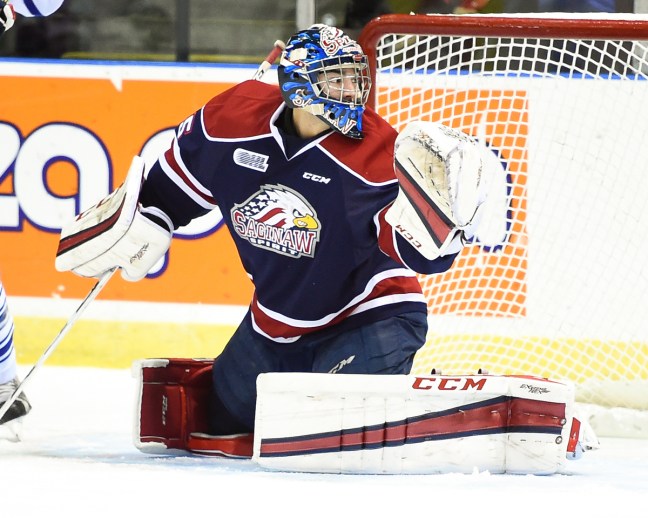
Evan Cormier Saginaw Spirit – Photo by Aaron Bell/OHL Images
Cormier moved on to the North Bay Trappers of the Northern Ontario Junior Hockey League for the 2013-2014 season. He appeared in 34 games and finished with 3.60 goals against average and .911 save percentage. Cormier got a brief 3 game stint with the Battalion that season with all three of his appearances coming in relief. He posted 0.72 goals against average and .967 save percentage. He stayed with the team through the playoffs but did not make an appearance.
Cormier began last season with the Battalion, but 8 games into the campaign he was traded to the Spirit along with 4 draft picks and 2 conditional picks for Nick Moutrey. He immediately became the team’s number one goaltender and started all 4 of the Spirits playoff games.
In April, Cormier represented Canada at the WJC Under18 where he started in two games. He came in for relief of Zach Sawchenko (Moose Jaw –WHL) in a third game against the United States. A 7-2 American win put Canada in the bronze medal game against Switzerland – a game they won.
At 6’3”, Cormier has good size. His post to post movement is above average. While he’s prone to giving up rebounds, he’s able to control them and direct them out of harm’s way. He challenges shooters very well, finds pucks through traffic and is strong in tight. Cormier is very good in shootouts and one on one. He has an excellent glove hand and very quick reflexes. He plays calm and cool in his net, and while he can let in a bad goal once in a while he rebounds well and doesn’t allow it to faze him. The problem is, those bad goals are coming to frequently right now.
Finding his consistency is Cormier’s challenge. He has the right frame of mind, the attitude and the willingness to work at improving and you could never fault him for having a bad work ethic.
Cormier made NHL Central Scouting’s list of players to watch as a B prospect – a second or third round pick.














 OHL Writers