Although it feels like spring out there it is November and that means it’s time to look at our draft eligible player of the month for October.
And he is: Alex DeBrincat of the Erie Otters.
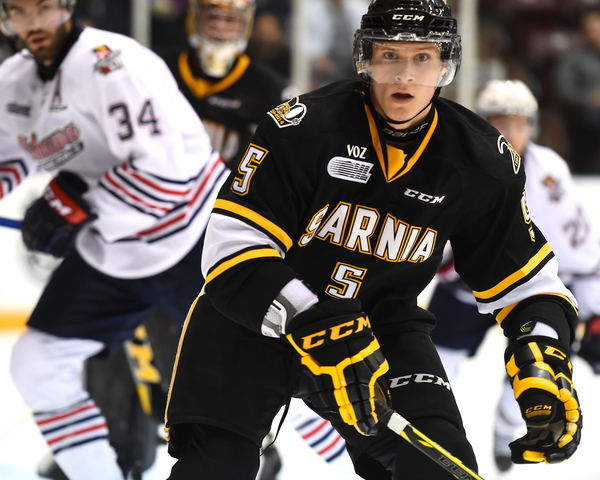
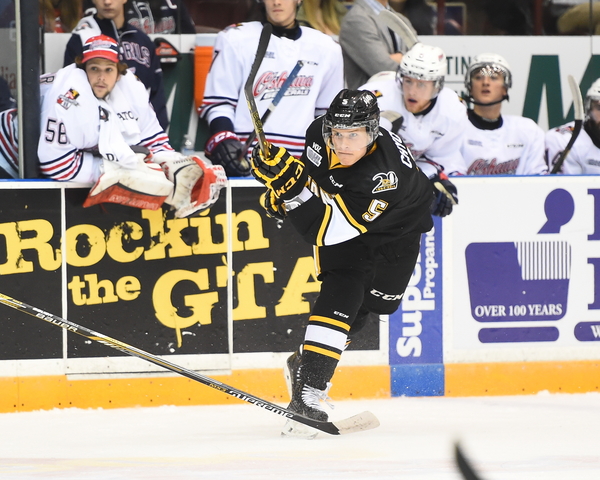
Alex DeBrincat of the Erie Otters. Photo by Aaron Bel/OHL Images
Through the month of October, DeBrincat played in 12 games scoring a league leading 16 goals and adding 7 assists for 23 points – also for the league lead – and finishing a plus 8. DeBrincat’s 16 goals came off of 57 shots on goal good for 28.07 shooting percentage. He also went 28 for 59 in the faceoff circle or 47.4 winning percentage.
DeBrincat was on fire to start the month scoring 5 goals versus the Niagara Ice Dogs on October 1st in Niagara and almost repeated the feat at home scoring 4 goals on October 9th in the rematch. He had seven multi point games and was held off the score sheet just twice. He was named the game’s first star five times and second star once.
DeBrincat was named OHL player of the week for the week ending October 4, 2015 and was runner up for the CHL player of the week for the same period.
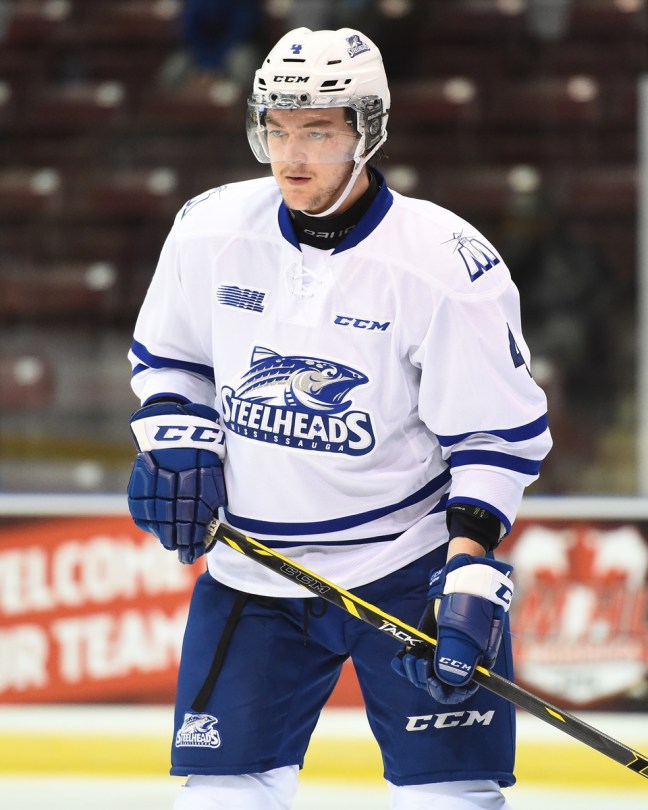
Also considered was DeBrincat’s teammate Taylor Raddysh who scored 4 goals and added 13 assists in 12 games and the Mississauga Steelheads’ Alexander Nylander with 9 goals and 9 assists in 13 games. In goal, the London Knights’ Tyler Parsons played all but 60 minutes of the Knights’ games and posted a 9-1-1-0 record with a 2.55 goals against average and .915 save percentage with one shutout.
Halloween has come and gone and we’ve seen multiple tricks and fabulous treats through the first full month of the Ontario Hockey League season.
With October games in the books, we look at those players eligible for the National Hockey League draft and who leads in a variety of statistical categories from points, to penalty minutes to time on ice.
As in previous seasons, we look at those players eligible for the NHL draft for the first time.
Date of Birth: December 18, 1997 – Detroit, Michigan
Position: Right Wing
Shoots: Right
OHL Draft: Undrafted, signed as a free agent.
First there was the Little Engine That Could: “I think I can, I think I can.”
Then, there is Alex DeBrincat: “I know I can, I know I can.”
Alex DeBrincat of the Erie Otters. Photo by Aaron Bell/OHL Images
The twice undrafted DeBrincat signed on with the Otters as a free agent after scoring 54 goals and adding 57 assists in just 50 games for Lake Forest Academy. He took the Ontario Hockey League by storm in his rookie season scoring 51 times to go along with 53 assists while playing in all 68 games. His goals were almost twice as many as his closest rookie rival while his points exceeded twice as many (Zachary Senyshyn: 26 goals, 45 points) en route to winning OHL and CHL rookie of the year.
Throughout last season I heard it many times: “anyone can score playing with McDavid” or “I could score playing with McDavid.”
While playing with a world class player like McDavid would benefit anyone, just how much did it? There are no OHL stats that indicate how much DeBrincat played with McDavid or OHL scoring leader Dylan Strome for that matter. So let’s look at it like this:
DeBrincat averaged .75 goals per game and .78 assists per game through his 68 games. In the 21 games that McDavid missed with injury and the World Junior Championships DeBrincat averaged .52 goals per game and 1.00 assist per game. With McDavid in the lineup terrorizing defences and opening up space, he averaged .85 goals per game and .68 assists per game.
His points per game with McDavid in the lineup stood at 1.53 points per game while without McDavid he averaged 1.52 points per game. Anatomize those numbers and you should come to a legitimate conclusion.
While there are no statistics available for last season of McDavid playing without DeBrincat in the lineup, one can come to a reasonable inference that as much as McDavid made DeBrincat a better goal scorer, DeBrincat made McDavid a better set up man.
There are however, some advanced stats available from CHL Stats
There is no doubt DeBrincat is relishing (and succeeding) in a larger role this season. Early on he’s averaging 28:21 of even strength ice time, up from 23:32 in even strength ice time as a rookie. I’m not suggesting he can continue his pace of 10 goals and 13 points in his first five games, but will suggest he’ll be right up there with the leaders by game 68. He’s already had two dominant performances in a 5 goal game and a 4 goal game.
There is no denying DeBrincat is very undersized. But he has superb speed to overtake guys one on one and is excellent at “hiding” and moving into the scoring areas at the right time. While his mindset playing with McDavid was that of a shoot first winger, he displayed his playmaking abilities in the latter’s absence. Despite the size issue, he is more than willing to play physical and is not dissuaded from going to the dirty areas.
DeBrincat is also an agitator and creates the impression that he enjoys the chirping game on the ice. He can lure the opposition into taking needless and foolish penalties and then work his magic on the powerplay.
There is no question that discussions about DeBrincat among National Hockey League teams will center on his size. Is he a first round talent? In this viewer’s eyes: absolutely. NHL teams will have to decide whether DeBrincat can be the Tampa Bay Lightning’s Tyler Johnson or the Calgary Flames’ Johnny Gaudreau.
Elite: aselect part of a group that is superior to the rest in terms of ability or qualities.
Why did I begin with the definition of elite? It’s become part of a broad characterization loosely attached to players; it should be restricted to the best of the best. That’s not to say a player can’t have a particular elite skill such as: skating or shot quality.
Will Chychrun fit the definition elite? Yes.
If you expect a franchise defenceman, look no further than Chychrun. He is everything you ask for in a defenseman and more. He has good size and fantastic skating to go along with it. As he grew accustomed to the faster pace of the OHL last season, the forward turned defenceman became harder to beat one on one.
He has elite vision and his hockey sense is unparalleled by any other defenceman in this draft class. He knows when to rush with the puck and when to dish off to a teammate with pinpoint accuracy. He is always one play ahead. Chychrun’s power play skills are also unrivaled. He has an Al MacInnis shot with the accuracy of a Raymond Bourque.
Chychrun is a communicator on the ice and on the bench. Despite his young age he has no problem communicating with players on the bench or directing traffic on the ice. He has tremendous leadership qualities – he was named an alternate captain as a rookie – and will one day captain an NHL team.
Jakob Chychrun – Courtesy Aaron Bell/OHL Images
Internationally, Chychrun played for team Ontario at the World Hockey Challenge Under-17 in 2014 as a member of the Toronto Jr Canadiens – a rarity. He missed the tournament in 2015 due to an injury. He also sat out the Ivan Hlinka Memorial in August with an injury.
The above mentioned tournaments are not sanctioned by the International Ice Hockey Federation; therefore Chychrun is not committed to play for Canada. He has dual citizenship and can play for either Canada or the United States, but once he commits, he can no longer switch allegiances. Chychrun has stated he wants to play for Canada and he should (will in my opinion) be a member of Team Canada at this year’s World Junior Championships. If he falls short, the US could welcome him with open arms if he so chooses.
All this has drawn comparisons to Aaron Ekblad – the first defenceman to receive exceptional status and the first overall pick in the 2014 NHL Draft. Personally, I believe Chychrun has slightly higher offensive abilities than Ekblad and is a better skater. Ekblad is slightly ahead of Chychrun in other categories at the same stage of their careers, but overall, the slight advantage goes to Chychrun.
I spoke with two people who have an incredible eye for talent: Brock Otten, who has his own excellent OHL blog here and Brendan Ross, Director of Scouting for TheScout.ca and head scout for DobberProspects.
OHLW: Chychrun had the opportunity to, and decided against, applying for exceptional status with Hockey Canada. How do you think that helped him in his preparation for what turned out to be a fantastic rookie season?
Otten: I’m of the opinion that if you’re talented and dedicated, it doesn’t matter what route you take, you’ll find success. By delaying his entry into the OHL, Chychrun was able to play for an exceptionally talented Toronto Jr. Canadiens club. While he missed the OHL Cup with a shoulder injury, he was incredibly important to that team. He also still got to suit up for the Team Ontario at the U17’s (as an underager), despite not playing in the OHL. Bottom line is that Chychrun likely sat down with his family and decided that he wasn’t ready for that jump yet. As others have found out (especially Sean Day recently), that exceptional status tag is a tough burden to carry sometimes. The expectations can be tough to deal with. By playing a year of MM and allowing his game to mature, he was able to grow as a player at both ends of the ice. So far, it’s proved to be a pretty smart choice.
Ross: From my understanding Chychrun grew up playing the game as a forward so opting against applying for exceptional status really allowed Jakob to focus on refining the aspects of his defensive game. He’s a natural athlete so adjusting to the physical demands of a different position came easier for him but the extra time gave him an opportunity to develop into a more complete player and that was evident throughout his minor midget draft year as he just kept improving with each passing game.
OHLW: There are some that believe entering his draft year that he is at the same level Aaron Ekblad was when entering his draft year. What are your thoughts on the comparison?
Otten: I actually thought that Chychrun was better than Ekblad during their 16/17 year old seasons. So I’d actually agree with that statement. Love Aaron and he improved so much over the course of his OHL career (especially as a skater and offensively), but Chychrun is the best two-way defender the OHL has seen since Drew Doughty IMO. Complete package and a true franchise defender. In comparison to Aaron, I think at the same age, Jakob displays a more natural offensive ability, in combination with better mobility. Just has to stay healthy.
Ross: The first time I watched Chychrun skate in his minor midget season I remember thinking and reporting that he appeared as good as (and possibly better) than the former Sun County Panther but that all has to be taken with a grain of salt. Although they play the same position, are similar in style and natural ability, they were certainly different kids with much different backgrounds and also playing in different leagues at the same age (Aaron in the OHL at 15 and Chychrun in the GTHL at 15). With that said, there are a lot of similarities with the two of them – first and foremost, their respect for the game and professional approach. One could certainly say that Chychrun is the better skater of the two while Ekblad likely holds the edge in power and strength. The elder Ekblad, as expected, is much more mature on the defensive side of the puck while Chychrun has the ability to create offense better on his own (end to end rushes, etc.) but that also comes with some risks. Comparisons aside, it’ll be a treat comparing these 1st overall OHL picks throughout their professional careers.
OHLW: What would you say his single greatest asset is?
Otten: That’s a tough question. The answer now may not be the answer at the end of the season. He’s such a complete player. If I had to pick something, I feel that his offensive hockey sense, in particular his ability to find holes in opposing defences to get in scoring position, is incredibly impressive for a player his age. He could score 25 goals this year.
Ross: Without a doubt his skating ability. His advanced and effortless mobility provides him advantages both offensively and defensively. Propelled by an elongated stride that provides both power and finesse in crisp edges, Chychrun is capable of bursting up ice in dazzling rushes and then quickly retreat to get back defensively. His ability to quickly close gaps is aided by quick changes in direction and high-end awareness. If I were to point to one single physical skill that makes Chychrun an elite talent, it’s definitely his skating abilities.
OHLW: If you can find a weakness in his game, or something that he needs to improve on, what would you say that would be?
Otten: Other than keeping that shoulder healthy, I think Chychrun is still learning to use his size consistently in the defensive end. This is something I expect a improvement in this year. He’s shown a willingness to engage off the rush and will throw the odd big hit, but playing with a ton of intensity in front of the net and in the corners is the next step to being a consistently physical defender. Showed that at times last year, but would love to see him become one of the toughest guys in the league to play against.
Ross: I had a feeling that this question was coming since everyone, including Jakob himself, is looking for areas to improve. Even after thinking long and hard, outside of his physical durability, it’s very difficult to pinpoint a weakness to his game. His injuries, specifically his shoulder problems, have been well documented over the last several seasons so it’s no secret that he’ll need to stay healthy in his draft season to dispel those concerns. Even with a well-rounded game, Chychrun can always find areas to improve. His natural puck moving abilities will certainly get people saying that he’ll need to improve his defensive game but in reality, his defensive awareness is very strong and an area he excels in. His tendency to activate into the rush presents opportunities for opposing teams to exploit his coverage but in today’s game where defenders are encouraged to hold the line and act as a fourth forward, that tendency is an asset. I think Jakob would probably tell you himself that he wants to become a defender that can be used in all situations at the next level but also one that can be especially trusted in shutting down top players. That is an area that even the most seasoned veterans must continually work on so Chychrun will make it a priority as well.
OHLW: Chychrun is currently ranked number two behind Auston Matthews in many draft rankings. Is there any scenario where you could see him seriously challenging Matthews for first overall?
Otten: Probably two scenarios. One, Matthews disappoints in Switzerland or he gets hurt. Or two, Chychrun has an incredible year, challenges for the Max Kaminsky (Top defender of the OHL), plays a role on the WJC team, and leads the Sting to a solid year…and a team looking for a franchise defender takes him first (god help us if the Oilers pick first again).
Ross: Absolutely. It’s a long draft year for these kids and there are too many examples of non-linear development curves. Matthews, Chychrun and several other eligible forwards all possess elite skill sets to challenge for 1st overall but at the moment, its Matthews followed by Chychrun. At this point in time, Chychrun holds a sizeable lead as the top defenseman available with only Olli Juolevi, Dante Fabbri and Kale Clague as contenders in his rear-view mirror. With Auston Matthews playing in the Swiss professional league, it makes the 1st overall watch especially intriguing. As previously mentioned, Chychrun needs to remain healthy and lead his Sarnia Sting team deep into the OHL playoffs to really challenge Matthews at the top.
OHLW: Chychrun’s game reminds you most of which current or past NHL player?
Otten: Not a big comparisons kind of guy. But…the guy that immediately came to mind was Rob Blake.
Ross: Player comparisons are the bane of my existence but I will bite. In terms of style, Jakob Chychrun plays a lot like Drew Doughty – possessing poise, confidence and great hockey instincts. Chychrun may be a better skater than Doughty but I see a similar NHL impact moving forward.
You can follow Brock on twitter here and Brendan here.
A survey I have done in past seasons is to poll the General Managers of the Ontario Hockey League teams with this: List your top 3 goaltenders, defencemen and forwards and the order they would be selected in the 2016 National Hockey League Draft.
This season I have expanded the survey to include head coaches, goaltending coaches, and directors of scouting as well as assistant general managers.
Players were given 7 points for a first place ranking, 4 points for second place and 1 point for third place. Based on the number of responses received, the maximum points a player could receive are 357 points.
Jakob Chychrun – courtesy Aaron Bell/OHL Images
Only one player received unanimous first place votes from all respondents: Sarnia Sting defenceman Jakob Chychrun. Of those 51 respondents, the vast majority, 40, had London Knights defenceman Olli Juolevi as their second choice.
The battle for top goaltender was for all intents and purposes a tie. Dylan Wells of the Peterborough Petes and Evan Cormier of the Saginaw Spirit ended with 24 first place votes apiece. The difference being Cormier received one fewer second place vote and an extra third place vote.
Among the forwards, the London Knights Matthew Tkachuk was the overwhelming favorite receiving 50 of a possible 51 first place votes. Tkachuk didn’t receive a second or third place vote. Now some of you may think that’s a General Manager trying to get a better result for his own player, but consider this: The one vote that went against him went to his London teammate Max Jones.
Compared to polls from previous seasons, the battle for goaltender has never been so tight – there was always a clear cut favorite: MacKenzie Blackwood, Alex Nedeljkovic, Spencer Martin and Malcolm Subban to name a few.
On defence, the only time we’ve had clear choices were Aaron Ekblad and Darnell Nurse. Up front, of course there was Connor McDavid a year ago, but you have to go back to Gabriel Landeskog at the beginning of the 2010-11 season to find an overwhelming favorite.
And our draft eligible player of the month for September is London Knights center Matthew Tkachuk.
In two games, Tkachuk scored twice and added four assists to lead the Knights to a 1-0-0-1 record. Tkachuk was dominant all over the ice in two games. He was a physical presence and created several offensive chances.
His two goals came on 8 shots for a 25% shooting percentage. He finished 13 for 26 in the face off dot for a 50% face off percentage.
The 2015-2016 Ontario Hockey League season is upon us. Hockey is back!!
The following is a team by team listing of players eligible for the 2016 National Hockey League Draft as listed by the 20 member OHL teams on opening night. Only players and goaltenders eligible for the first time are listed – those passed over in previous NHL drafts are not included.
What do Sean Day, John Tavares, Aaron Ekblad and Connor McDavid have in common? All four were granted exceptional status by Hockey Canada and allowed to join the Ontario Hockey League as underage players. What is dissimilar among the four? The latter three were first overall picks in the National Hockey League draft for their respective draft years. Day will not be in the elite trio’s company.
In fact, Day was not the first overall pick in the OHL Priority Selection back in 2013 after being granted exceptional status. Travis Konecny (Ottawa 67’s), Dylan Strome (Erie Otters) and Matthew Spencer (Peterborough Petes) were selected ahead of him.
Day enters his third OHL season – his draft year – after less than spectacular rookie and sophomore seasons. He scored 6 goals and added 10 assists finishing with a minus 35 in 60 games during his rookie campaign. Day was named to the OHL second rookie team.
Last season he upped his totals to 10 goals and 26 assists with a minus 27 in 61 games. Don’t let the horrid plus/minus fool you – that can also be attributed to the less than stellar performance of the Steelheads.
Day has shown flashes of brilliance, but not with the consistency needed from a possible (as some opinions would have it) top ten NHL pick. Day is an effortless skater who can get up and down the ice with relative ease which has led to a few Paul Coffey comparisons (Day also compares himself to the Hall of Famer). He can carry the puck up ice with confidence and poise a la Coffey and like Coffey, he thinks offense first but can get caught up ice. His elite skating, however, allows him to get back more often than not. Day can throw a big hit but his physicality isn’t where it should be considering his size. Too often he shows a lack of interest or desire to battle along the boards for pucks.
There is no doubt Day can be an exceptional offensive catalyst with elite skill. He needs to work on his decision making skills by learning when to pinch or join the rush and not always being reliant on his skating to get back to the defensive zone. Instead of going end to end he could simply better read the play in front of him and dish off to a teammate, that way he would not get caught up ice. In the O-zone he has the ability to get pucks through lanes or find the seams but needs to do it on a more consistent basis.
Day has the ability to make a good first pass but too often he tries to force a play that isn’t there. He possesses an excellent shot and can quarterback the power play. His downfall may just be his decision-making skills or lack thereof. I just haven’t seen the hockey sense that should go hand in hand with elite talent such as Day’s. He certainly has all the tools of a potential high first round pick –there are those that still rank him as a top 10 pick – but to me, his lack of hockey sense drops him all the way down to the second round.
It’s a long way off until June 2016 when NHL teams gather in Buffalo, NY to find the next big superstar. Anything can happen and Day will have 68 games and the playoffs (?) to prove that.
Being cut from Team Canada at the Ivan Hlinka Memorial Tournament in August was not a good start entering his draft year. However it is one tournament and not the be all end all.
Now, if he can use it as motivation….
Quotes:
Sherry Bassin to CBC Sports:
“He outskates everyone so much at this level,” said Bassin. “He joined the rush in some of the games I saw and he literally had to stop at the [opposing] blue-line. He would be so far ahead of everyone else, as a defenceman.”
Brendan Ross on the Hockey Writers:
It will be a tragic day if Hockey Canada’s fourth ever exceptional player falls to the number four slot but it seems like a real possibility. In all of my years of watching minor midget hockey, Sean Day is the best skater hands down. In all areas of skating ability — acceleration, agility, top-end speed, edge work, etc. — Day walks away as the best of the best. His competitiveness and hockey sense are two areas of question but he likely owns the highest upside of any player in this draft class.










 OHL Writers